


Modern industrial automation requires more than fast movement. Many assembly processes also need controlled and repeatable force when machines interact with small or delicate components. A closed-loop actuator can use feedback signals to monitor actual force and adjust its output during operation. Therefore, this control method helps reduce force variation and maintain more consistent production results. The electric force control linear actuator combines precise force regulation with integrated motion capabilities for demanding automation applications.
How Closed-Loop Force Control Improves Precision
Traditional motion control mainly focuses on position or speed. However, force-sensitive assembly requires the system to respond to changes in the actual load. A closed-loop architecture continuously compares the target force with feedback from the operating process, then adjusts the actuator response when the force changes. As a result, the system can maintain a more stable output during pressing, insertion, fastening, and other controlled-contact operations. Feedback-based force control is widely associated with applications that require consistent contact force and repeatable motion.
Real-Time Feedback for Stable Pressure Regulation
Real-time feedback is central to precise force regulation. When the external load changes, the actuator can detect the difference through its feedback system and adjust motion accordingly. Moreover, this dynamic response helps reduce variation between individual production cycles. For high-speed manufacturing, stable force output can support consistent component handling without relying only on fixed mechanical positions.
The electric force control linear actuator is designed around this type of control concept. Instead of simply moving to a predefined position, it can respond to changing force conditions during operation. Consequently, OEM equipment builders can integrate force-sensitive motion into processes that require controlled contact and repeatable performance.
Integrated Linear-Rotary Motion for Compact Automation
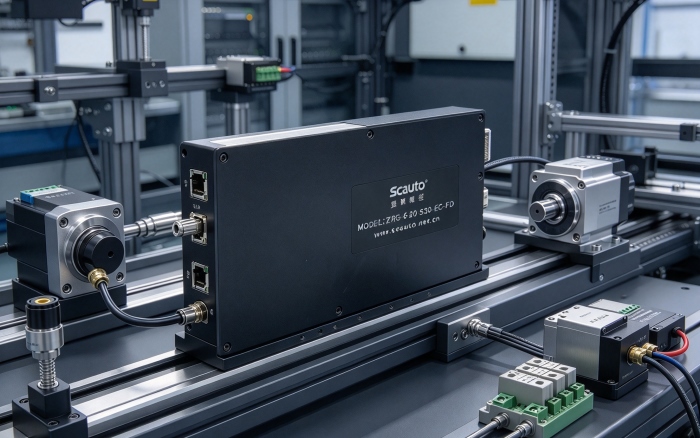
Space is another important consideration in modern automation equipment. The ZRGDS6-20 series combines linear and rotary motion within one integrated actuator structure. Therefore, equipment designers can coordinate two types of movement within a compact module instead of relying on multiple independent motion components. This configuration can simplify mechanical integration while supporting synchronized movement.
Furthermore, the compact structure suits OEM equipment layouts where installation space is limited. The integrated design can support applications such as insertion, placement, fastening, and other precision assembly operations. By combining force control with coordinated motion, the actuator provides a broader motion-control function for automated machinery.
Core Functional Features
The actuator focuses on several functions that directly support industrial automation. These features work together rather than operating as isolated specifications.
| Feature | Functional Role | Industrial Value |
|---|---|---|
| Closed-loop force control | Continuously regulates force output | Improves force consistency |
| Real-time feedback | Detects changing operating conditions | Supports dynamic adjustment |
| Linear motion | Provides controlled straight-line movement | Suitable for insertion and pressing |
| Rotary motion | Adds synchronized rotational movement | Supports integrated assembly tasks |
| Compact structure | Reduces installation requirements | Helps OEM equipment integration |
| High-speed operation | Supports continuous motion cycles | Fits automated production lines |
| Repeatable control | Maintains consistent operation | Reduces process variation |
Applications in Precision Manufacturing
Force-controlled motion benefits many industrial processes where excessive or inconsistent pressure can affect component quality. For example, automated insertion equipment may need controlled contact when handling small electronic components. Similarly, bonding, fastening, and pick-and-place systems can require repeatable movement and controlled interaction with workpieces.
Typical applications include:
- 3C electronic assembly automation
- Micro-component insertion equipment
- Precision bonding and fastening machines
- Automated pick-and-place platforms
- Semiconductor auxiliary processing equipment
- Factory automation production lines
- High-precision manufacturing systems
These applications share a common requirement: the motion system must respond consistently when operating conditions change. Therefore, closed-loop force control can provide an additional layer of process control beyond basic position and speed management.
OEM Integration and Industrial Value
For OEM equipment builders and system integrators, actuator integration affects both machine performance and overall system design. A force-control module can reduce the need for separate motion components when the application requires coordinated movement and force regulation. Moreover, the compact linear-rotary structure can help simplify equipment layouts and support more flexible machine designs.
Zrvrobot focuses on actuator technology for industrial automation applications where controlled force, repeatable motion, and compact integration are important. The electric force-controlled linear actuator can support equipment developers working on high-speed assembly and precision manufacturing systems. In addition, its integrated architecture provides a practical foundation for customized automation equipment.
Why Closed-Loop Control Matters for Future Automation
As manufacturing processes become more precise, machines increasingly need to react to real-time operating conditions rather than follow fixed motion commands. Closed-loop force control provides this feedback-based approach by connecting force information with motion adjustment. Therefore, it can help automation systems maintain more consistent interaction with components during repeated production cycles.
Overall, the combination of real-time feedback, force regulation, and integrated linear-rotary movement makes the actuator suitable for precision automation. The electric force control linear actuator provides OEMs and system integrators with a flexible motion-control option for applications that require controlled pressure and repeatable operation. By combining compact integration with responsive force management, this actuator concept can support more stable and efficient industrial automation processes.