


Modern industrial automation requires faster cycle times without sacrificing positioning accuracy or process stability. When a machine needs both linear movement and rotary positioning, coordinating two independent motions can otherwise increase mechanical complexity and control demands. A dual-axis servo linear rotary actuator integrates these two motion functions into one compact automation component, allowing synchronized movement within a controlled process. Therefore, this approach can help manufacturers simplify motion sequences while improving throughput in applications that require fast and repeatable handling.
Synchronized Motion for Faster Automation Cycles
A major advantage of a dual-axis motion architecture is the ability to coordinate linear travel and rotary movement within the same operating sequence. Instead of completing each motion through separate mechanisms, the actuator can perform controlled positioning and rotation as part of a synchronized cycle. This reduces unnecessary pauses between operations and helps machines maintain a more continuous workflow. Moreover, coordinated motion can improve repeatability when components need to be moved, rotated, aligned, or inserted in a specific sequence. Research and commercial actuator designs similarly demonstrate the value of combining linear and rotary motion for precision assembly and pick-and-place processes.
Dual-Servo Control Improves Positioning Consistency
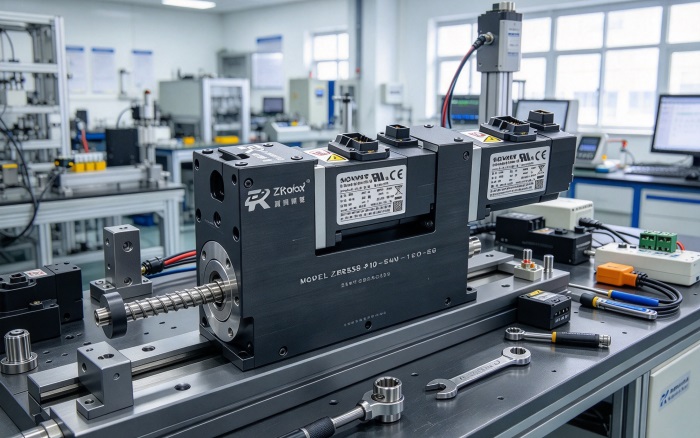
The ZRBSS8-P10 uses a dual-servo configuration to manage linear and rotary motion with greater control. Because the two motion axes can be coordinated during operation, the actuator supports accurate positioning while maintaining stable movement at high operating speeds. In addition, this architecture is useful when production equipment must repeatedly perform complex motion patterns without introducing unnecessary mechanical conversions. As a result, manufacturers can achieve more consistent cycle performance across continuous production runs.
Key Motion and Integration Advantages
| Feature | Automation Value |
|---|---|
| Dual-servo configuration | Coordinates linear and rotary movement |
| Compact structure | Saves installation space |
| High-speed operation | Supports shorter machine cycles |
| 60N thrust output | Provides reliable linear force |
| Soft-landing function | Helps protect delicate components |
| Medium pneumatic circuit | Supports smooth operational movement |
| Integrated linear-rotary motion | Simplifies equipment integration |
Soft Landing Supports Delicate Material Handling
High-speed automation is not only about moving quickly. The actuator must also control how components contact tools, fixtures, or other materials. The soft-landing function of the ZRBSS8-P10 helps reduce sudden impact when the actuator approaches a working position, which is particularly useful for delicate parts and precision handling processes. Furthermore, smoother landing behavior can contribute to more stable production by reducing unnecessary mechanical shock during repeated cycles. This capability becomes especially valuable in labeling, film application, patch placement, and irregular insertion tasks. These processes may require an actuator to approach a component, complete a controlled movement, and then reposition rapidly for the next cycle. Therefore, combining speed with controlled landing can help maintain both productivity and process consistency.
Compact Design Simplifies Automation Integration
Space is another important consideration when designing modern production equipment. A compact actuator can reduce the installation footprint while providing two types of controlled movement within one integrated unit. Consequently, machine designers can simplify certain mechanical layouts and reduce the need for separate linear and rotary components. For suppliers and OEM manufacturers, this integrated structure can also make equipment upgrades more flexible. Instead of designing independent mechanisms for every motion requirement, engineers can use one actuator to coordinate multiple movement functions. Zrvrobot develops motion-control products for industrial automation applications where compact integration, repeatability, and production efficiency are important considerations.
Applications Where Synchronized Motion Adds Value
The combination of linear and rotary movement is particularly suitable for automated processes that require positioning followed by orientation or controlled insertion. Because both movements can be coordinated, the actuator can support a wider range of machine sequences than a simple linear actuator.
Key application areas include:
- Labeling automation: positions and aligns materials before application.
- Film application: supports controlled positioning and smooth material handling.
- Patch placement: enables accurate movement and orientation during placement.
- Irregular insertion: combines linear insertion with controlled rotary positioning.
- Pick-and-place operations: improves coordinated positioning for automated handling.
- Loading and unloading: supports repeatable movement within compact equipment layouts.
How Synchronized Motion Boosts Production Throughput
Production throughput depends on more than actuator speed. It also depends on how efficiently each motion is completed within the overall machine cycle. A dual-axis servo linear rotary actuator can coordinate movement sequences, reduce unnecessary transitions, and support repeatable operation. Consequently, equipment designers can improve cycle efficiency while maintaining the positioning performance required for automated manufacturing.
Furthermore, stable motion can help reduce interruptions caused by inconsistent positioning or material handling. When combined with high-speed operation and soft landing, synchronized motion provides a practical balance between productivity and controlled movement. This makes the technology suitable for continuous manufacturing environments where every cycle contributes to overall output.
A Practical Motion Solution for High-Speed Automation
As industrial equipment becomes more compact and production cycles become faster, integrated motion control is increasingly important. The ZRBSS8-P10 combines dual-servo linear and rotary movement, compact integration, 60N thrust, soft landing, and pneumatic optimization in a single actuator design. Therefore, the dual-axis servo linear rotary actuator can support automation processes that require coordinated positioning, orientation, and material handling. Overall, synchronized linear and rotary motion can help simplify machine architecture while improving cycle efficiency and repeatability. For applications such as labeling, film application, insertion, pick-and-place, and automated loading, this integrated approach provides a flexible foundation for high-speed industrial automation.