


Modern semiconductor equipment requires precise handling, fast movement, and efficient use of installation space. However, conventional equipment designs may use separate motion modules and vacuum subsystems, which can increase wiring, tubing, installation requirements, and overall mechanical complexity. Therefore, integrating these functions into one compact architecture can provide significant advantages for equipment designers. A linear rotary actuator with vacuum combines vacuum handling with multi-axis motion, allowing a single module to perform positioning and suction-related operations within a coordinated system. As a result, equipment builders can create more compact automation platforms while improving synchronization between material handling and motion control.
Integrated Motion and Vacuum Architecture
The ZRFDS6-15 series is designed around an integrated architecture that combines vacuum handling and motion execution within one module. Instead of relying on a separate vacuum subsystem alongside independent motion components, the integrated structure helps simplify the overall equipment layout. Furthermore, fewer separate components can reduce the complexity of mechanical installation and system coordination. This approach is particularly valuable in semiconductor manufacturing, where equipment often needs to perform precise movements within restricted spaces. Consequently, integrating motion and vacuum functions can provide a more streamlined foundation for high-precision automation.
Ultra-Thin Structure for Compact Equipment
Installation space is an important consideration when designing semiconductor and advanced manufacturing equipment. Equipment layouts often contain multiple modules, sensors, cables, pneumatic lines, and control components, leaving limited room for additional mechanisms. Therefore, the ultra-thin structural design of the ZRFDS6-15 series provides a practical advantage. Its compact architecture can be embedded directly into equipment platforms without occupying excessive space. Moreover, reducing the physical footprint of the motion system gives engineers greater flexibility when arranging other critical components. As a result, the overall equipment can achieve a cleaner and more space-efficient mechanical layout.
Stable Performance During High-Speed Operation
High-speed production requires more than rapid movement because repeated cycles must also remain stable and predictable. The ZRFDS6-15 series is designed to support consistent operation during continuous automated processes. Furthermore, stable motion can help maintain accurate positioning when transferring wafers, chips, or other small components. When vacuum handling is coordinated with movement, the system can complete material transfer steps more efficiently. Therefore, combining stable high-speed motion with integrated vacuum control can help improve production consistency and reduce unnecessary delays between process stages.
Precision Handling for Semiconductor Applications
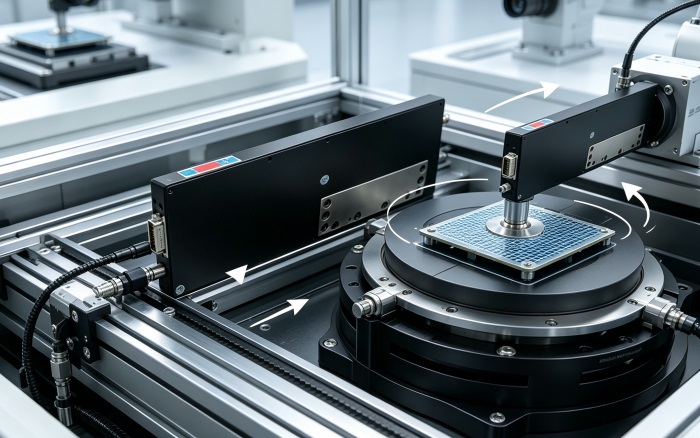
Semiconductor manufacturing involves delicate materials that require controlled handling and accurate positioning. A linear rotary actuator with vacuum can support these requirements by combining movement and suction functions in a coordinated architecture. Linear motion can position a workpiece along the required path, while rotary movement can adjust its orientation. At the same time, vacuum handling can assist with transferring the material securely. Consequently, the integrated approach is suitable for wafer transfer, chip inspection, packaging equipment, and other precision processes where movement accuracy and controlled material handling are essential.
Key Advantages of Integrated Design
The integrated architecture provides several practical benefits for equipment builders and automation engineers. In particular, it can help reduce the number of independent modules required within a machine while improving coordination between different functions.
- Integrated vacuum and motion: Combines suction control with multi-axis movement in one compact architecture.
- Space-efficient structure: Helps equipment designers work within limited installation areas.
- Stable operation: Supports repeated high-speed production cycles.
- Precision handling: Suitable for wafer and micro-component transfer applications.
- Simplified engineering: Reduces the need for separate vacuum and motion subsystems.
- Improved synchronization: Coordinates vacuum handling and movement more efficiently.
- Flexible integration: Supports direct embedding into industrial automation equipment.
Integrated Design Compared with Separate Systems
A separate motion and vacuum architecture may require individual actuators, vacuum components, tubing, mounting structures, and control arrangements. By comparison, an integrated module can combine several of these functions within a unified structure. This can simplify mechanical planning and reduce the number of interfaces that engineers need to manage. However, the appropriate solution still depends on the required motion range, vacuum performance, load, speed, and equipment architecture. Therefore, an integrated design is particularly beneficial when compactness, synchronization, and simplified installation are important project priorities.
| Design Approach | Motion Control | Vacuum Handling | Space Efficiency | System Complexity |
|---|---|---|---|---|
| Separate Modules | Independent | Independent | Moderate | Higher |
| Integrated Module | Combined | Combined | High | Lower |
| ZRFDS6-15 Series | Multi-axis | Integrated | Ultra-compact | Simplified |
Simplifying Semiconductor Equipment Engineering
Equipment builders must often coordinate mechanical, electrical, pneumatic, and control requirements during machine development. Therefore, reducing the number of independent subsystems can make engineering more manageable. The ZRFDS6-15 series provides an engineering-ready structure that can be embedded into automation platforms, helping designers reduce redundant components. Furthermore, integrated functionality can simplify synchronization between vacuum actions and mechanical movement. As a result, engineers can focus more efficiently on process optimization, equipment layout, and production performance.
Typical Applications
The ZRFDS6-15 series can support a variety of precision automation applications. In semiconductor wafer handling systems, it can assist with controlled transfer and positioning. Similarly, chip inspection and packaging equipment can benefit from coordinated movement and vacuum handling when working with small components. In 3C precision assembly lines, the compact structure can help optimize machine layouts where installation space is restricted. Furthermore, thin-film processing, micro-component manipulation, automated placement, and precision industrial assembly can benefit from a unified motion and vacuum solution.
Supporting Scalable Automation Platforms
Modern manufacturing systems often need to support flexible production requirements and future equipment upgrades. Therefore, a modular and compact motion architecture can provide useful flexibility during machine development. The integrated design of the ZRFDS6-15 series can support scalable automation platforms while reducing unnecessary subsystem redundancy. Moreover, its compact structure allows system builders to optimize the placement of other equipment components. Consequently, the module can contribute to cleaner machine architecture and more efficient production system development.
Why Choose Zrvrobot?
Zrvrobot focuses on motion solutions designed for advanced industrial automation and precision manufacturing applications. The ZRFDS6-15 series combines motion control and vacuum handling within a compact, ultra-thin architecture, providing a practical solution for equipment builders and automation integrators. In addition, stable high-speed operation and precision handling capabilities make the module suitable for demanding manufacturing environments. Therefore, it can help engineers develop more compact equipment while simplifying motion-vacuum coordination.
A Smarter Approach to Integrated Motion
A linear rotary actuator with vacuum provides an effective approach for equipment that requires coordinated movement and vacuum handling within limited installation space. By combining these functions into one architecture, the ZRFDS6-15 series can reduce subsystem complexity, improve synchronization, and support precise material handling. Meanwhile, its ultra-thin design and stable high-speed performance make it suitable for semiconductor and advanced manufacturing applications. Ultimately, integrated motion and vacuum technology can help equipment builders create more compact, efficient, and streamlined automation systems.