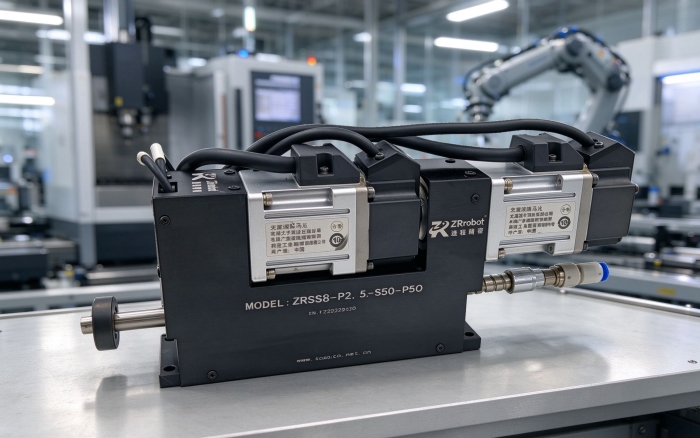


Modern industrial automation depends on motion components that provide stable operation, flexible integration, and efficient use of machine space. A long-stroke efficiency ZR axis module helps address these needs by supporting extended travel in automated equipment while maintaining consistent motion output. For manufacturers handling labels, films, swing plates, and microcomponents, this capability can simplify motion planning and support repeatable production processes. Moreover, an integrated motion design can reduce the need for multiple mechanical sections, allowing equipment designers to develop more streamlined automation systems.
Why Long-Stroke Motion Matters in Industrial Automation
Long-stroke applications often require equipment to move components across a wider working range without compromising positioning stability. However, building extended travel into a machine can increase structural complexity if multiple motion units or mechanical stages are needed. A high-efficiency compound actuator can help combine motion functions in a compact assembly, depending on the application requirements. Consequently, machine builders can evaluate more integrated designs that support flexible layouts and efficient movement during continuous production.
Key Features of the REMM8-X3 Series
The REMM8-X3 Series Long-Stroke High-Efficiency ZR Axis Module is designed for industrial applications that require extended motion capability and practical system integration. Its medium air circuit design supports compatible pneumatic configurations, while its cost-effective design makes it suitable for equipment projects where performance and overall system cost both matter. In addition, the module is intended for repeated industrial operation, helping engineers plan motion sequences around the needs of their production processes.
Key design considerations include:
- Long-stroke capability: Supports applications requiring an extended working range.
- Medium air circuit design: Provides a pneumatic configuration that engineers can evaluate against system requirements.
- Integrated motion coordination: Supports combined linear and rotary movement where required by the application.
- Flexible equipment integration: Can be assessed for different machine layouts and automation structures.
- Cost-effective design: Helps equipment manufacturers consider overall value during component selection.
Together, these characteristics give machine builders a practical starting point for designing automation systems around extended travel requirements.
Applications Across Production Environments
A long-stroke efficiency ZR axis module can be considered for swing plate positioning, labeling, film application, and the loading or unloading of microcomponents. For example, labeling equipment may require coordinated movement between a workpiece and an application station, while film processing systems may need controlled transfer across different positions. Similarly, microcomponent handling equipment can benefit from a motion solution selected to match its required travel, payload, and positioning sequence. Therefore, application-specific assessment remains essential when integrating the module into a production line.
For a ZR axis for a precision transmission system, engineers should evaluate travel distance, repeatability, mounting conditions, and the interaction between the module and adjacent mechanisms. A ZR module for a miniaturized precision processing device may also be considered when the equipment needs a carefully planned motion layout within restricted installation space. However, the actual suitability depends on the device dimensions, required accuracy, operating cycle, and verified product specifications.
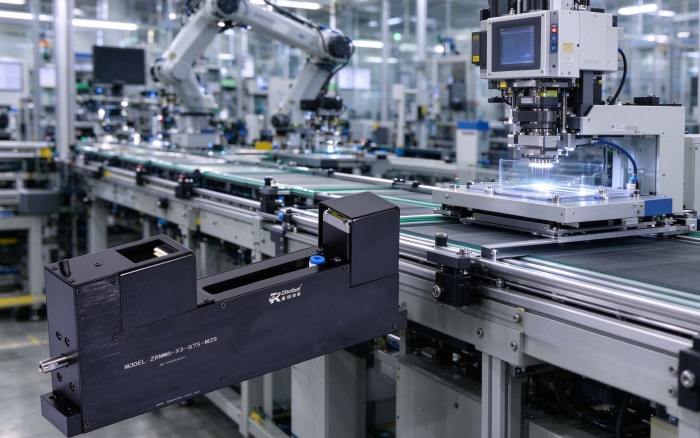
Technical Overview and Selection Factors
The following table summarizes the supplied product information and the main considerations for system integration.
| Item | REMM8-X3 Series Details | Selection Consideration |
|---|---|---|
| Product type | Long-stroke ZR axis module | Confirm compatibility with the required motion sequence |
| Design focus | High efficiency and cost-effectiveness | Compare overall system requirements and cost |
| Pneumatic configuration | Medium air circuit design | Check air supply and connection requirements |
| Motion capability | Extended travel and integrated motion coordination | Verify travel range and movement requirements |
| Swing plate applications | Supported as a target use case | Assess workpiece position and movement path |
| Labeling and film application | Suitable target applications | Check placement sequence and material handling |
| Microcomponent loading and unloading | Suitable target application | Confirm payload, dimensions, and required repeatability |
This overview helps engineers organize initial selection criteria. Nevertheless, final integration should be based on the complete technical documentation and confirmed operating specifications.
Choosing an Industrial ZR Module Manufacturer
When selecting an industrial ZR module, manufacturers should consider more than the nominal travel range. They should also review installation dimensions, pneumatic requirements, motion control compatibility, cycle frequency, and maintenance access. Furthermore, evaluating these factors early can help reduce design changes during commissioning and improve coordination between the motion component and the wider automation system.
An experienced ZR module manufacturer can help clarify product specifications and assess whether a particular configuration fits the intended application. Zrvrobot offers ZR axis module solutions for industrial automation, giving equipment builders a basis for discussing motion requirements and integration needs. As a result, OEMs and system integrators can make more informed decisions when planning equipment layouts and sourcing motion components.
Improving Production Efficiency Through Better Motion Planning
Extended travel, flexible integration, and stable operation can all contribute to a more efficient automation design when matched to the production task. The REMM8-X3 Series provides a long-stroke motion option for swing plate positioning, labeling, film application, and microcomponent handling applications. Ultimately, evaluating the working range, operating conditions, and interface requirements before installation helps manufacturers select an appropriate motion solution and build production systems with greater layout flexibility.