


In modern automation systems, equipment performance directly affects production efficiency, product quality, and operational stability. For precision manufacturing processes, motion accuracy, response speed, and structural reliability are essential factors that determine whether an automation component can meet industrial requirements. The industrial-grade ZR manipulator is designed to provide stable motion control and reliable operation in demanding manufacturing environments. However, several factors, including mechanical structure, servo control technology, application requirements, and operating conditions, can influence its overall performance. Therefore, understanding these factors helps manufacturers select suitable automation solutions and achieve more efficient production processes.
Structural Design and Mechanical Stability
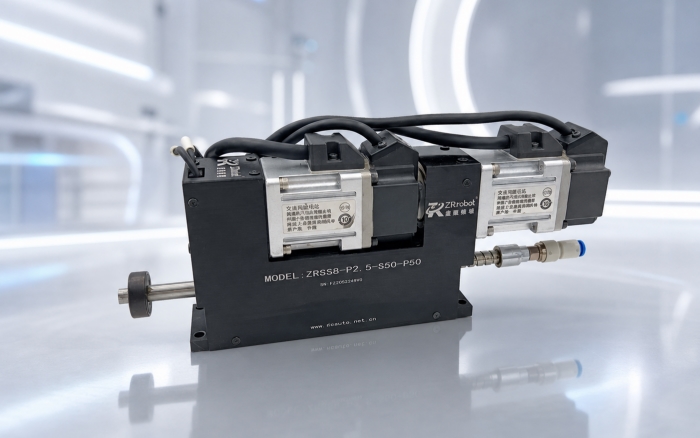
First, the mechanical structure plays an important role in determining the performance of an automation module. A compact and stable design can improve positioning accuracy while reducing unnecessary vibration during operation. The ZRBSS8-P2.5 series 50N high-thrust soft-landing ZR axis module from Zrvrobot features a compact structure and optimized mechanical design. In addition, its dual-axis servo system provides accurate Z-axis movement and smooth R-axis rotation, allowing the module to complete complex tasks with greater stability. As a result, the industrial-grade ZR manipulator can maintain consistent performance during continuous production operations.
Servo System Accuracy and Motion Control
Furthermore, servo technology is another important factor affecting manipulator performance. A high-quality servo system directly influences movement speed, positioning accuracy, and repeatability. The ZRB series uses a dual-axis servo system to achieve precise control during automated processes. Moreover, the optimized control system allows the manipulator to respond quickly to movement commands while maintaining smooth operation. Therefore, manufacturers can reduce positioning errors and improve production consistency, especially in applications requiring accurate handling and placement.
Load Capacity and Soft-Landing Performance
In addition, load capability has a significant impact on automation efficiency. Different production tasks require different levels of pushing force and handling ability. The ZRBSS8-P2.5 series provides up to 50N high thrust, making it suitable for applications that require stronger processing capability. Moreover, its soft-landing function helps reduce impact force during contact operations. As a result, the industrial-grade ZR manipulator can handle delicate components more safely while improving production reliability.
Air Path Design and Operating Stability
Additionally, pneumatic design can influence movement smoothness and operational efficiency. An optimized air path helps maintain stable airflow and improves response performance during repeated movements. The ZRBSS8-P2.5 series adopts a medium air path design, which supports stable operation in different automation scenarios. Therefore, it can achieve reliable performance in applications involving frequent movement and precision positioning. Moreover, stable pneumatic performance helps reduce fluctuations during long production cycles.
Application Requirements and Working Environment
Furthermore, the actual application environment also affects manipulator performance. Factors such as component size, material characteristics, operating frequency, and installation conditions must be considered before selecting an automation module.
The ZRB series is widely applied in:
- Label attachment
- Film bonding processes
- Patch installation
- Auxiliary material attachment
- Irregular insert handling
- Component loading and unloading
In addition, these applications require accurate movement and reliable contact control. Therefore, choosing a suitable configuration can significantly improve production efficiency.
Maintenance and Long-Term Performance
Moreover, regular maintenance is essential for maintaining stable equipment performance. Proper inspection of mechanical components, servo systems, and operating conditions helps extend service life. With reliable structural design and precision manufacturing, Zrvrobot provides automation solutions that support long-term industrial operation. In addition, the combination of durable components and advanced motion control technology helps manufacturers reduce downtime and improve productivity.
Conclusion
In conclusion, the performance of an automation module depends on multiple factors, including structural design, servo accuracy, load capability, air path optimization, and application requirements. The industrial grade ZR manipulator combines a compact structure, dual-axis servo system, and 50N high-thrust soft-landing technology to provide stable and efficient motion performance. With the support of Zrvrobot, manufacturers can achieve more reliable automation processes for labeling, bonding, handling, and precision assembly applications.