


In the fast-paced world of 3C electronics manufacturing, production lines demand components that deliver precision, speed, and value without occupying excessive space. A cost-effective linear rotary actuator meets these requirements by combining linear and rotary motion in a single compact unit. This dual-function design supports accurate micro-component handling while helping manufacturers control equipment costs. As a result, factories can achieve higher throughput and more consistent quality. Zrvrobot has developed the ZRADM6-15 series specifically to address these needs in semiconductor and 3C assembly environments.
Why Cost-Effectiveness Matters in Modern Assembly
A cost-effective linear rotary actuator reduces the total investment required for multi-axis motion systems. Instead of purchasing and integrating separate linear and rotary stages, manufacturers gain both functions in one ultra-thin package. Furthermore, the simplified mechanical structure lowers maintenance demands and shortens installation time. In addition, the high cost-effectiveness of the design allows companies to equip more stations without exceeding budget limits. Consequently, production managers can scale automation more readily while preserving capital for other critical upgrades.
Core Design Elements That Deliver Performance
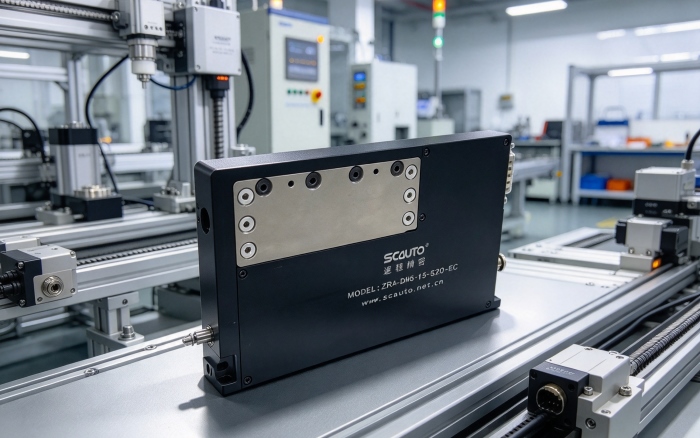
The ultra-thin body maximizes space efficiency on crowded factory lines where every millimeter counts. High Z-axis precision ensures accurate vertical placement of delicate micro-components, while the medium-precision R-axis provides reliable rotary positioning for standard accuracy tasks. Moreover, precise force control protects sensitive parts during pick-and-place cycles, and high-speed operation supports continuous, rapid production. Therefore, the actuator maintains stable performance even under demanding shift conditions. These combined features make the system particularly suitable for semiconductor device assembly and 3C electronics manufacturing.
Practical Advantages for Production Teams
Several operational benefits become clear when the actuator is deployed on the line. First, the compact form factor frees valuable workspace for additional process stations. Second, integrated linear and rotary motion reduces the number of separate mechanisms that must be coordinated. Third, robust force control minimizes damage to fragile components and lowers scrap rates. Fourth, easy integration supports both OEM and supplier production environments. Taken together, these strengths improve overall line efficiency and reduce the need for manual intervention.
| Aspect | Traditional Separate Axes | Cost-Effective Linear Rotary Actuator |
|---|---|---|
| Space Requirement | Larger footprint | Ultra-thin compact design |
| Motion Integration | Multiple units and controllers | Single unit with linear + rotary motion |
| Precision Balance | Often over-specified or uneven | High Z-axis + medium R-axis accuracy |
| Force Control | May require extra sensors | Built-in precise force management |
| Total Cost of Ownership | Higher hardware and integration | Lower investment with strong performance |
The table illustrates how a unified design delivers both technical and economic advantages for high-volume 3C lines.
Supporting Continuous and Reliable Operation
High-speed capability enables rapid pick-and-place cycles that keep pace with modern electronics production targets. In addition, the actuator integrates smoothly into existing automation systems, allowing suppliers and OEM clients to upgrade lines with minimal disruption. Furthermore, consistent performance across extended operating periods helps maintain product quality and reduces unexpected downtime. As a result, manufacturers gain a practical tool for improving throughput while controlling operational costs. Zrvrobot focuses on these balanced characteristics so that customers can deploy reliable motion solutions across semiconductor and 3C applications. In summary, a cost-effective linear rotary actuator provides an efficient path to higher productivity on 3C manufacturing lines. By combining ultra-thin construction, precise force control, high-speed capability, and dual-axis motion in one unit, the system addresses both technical demands