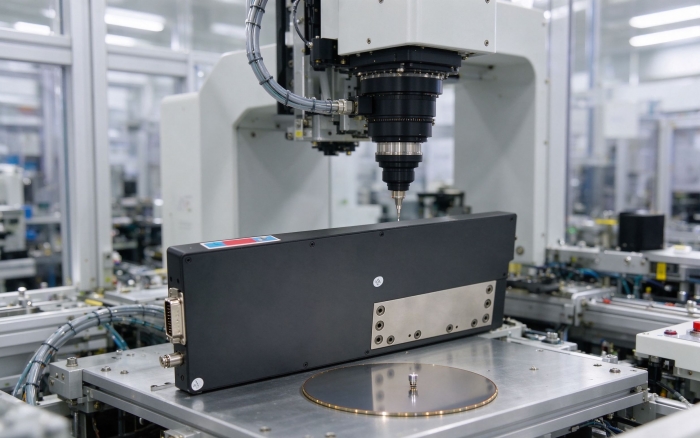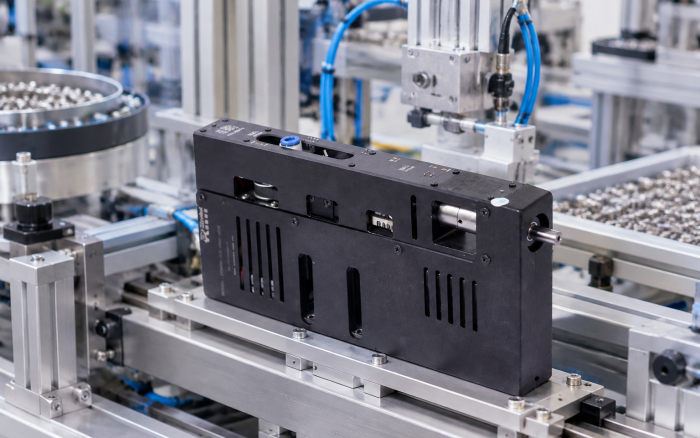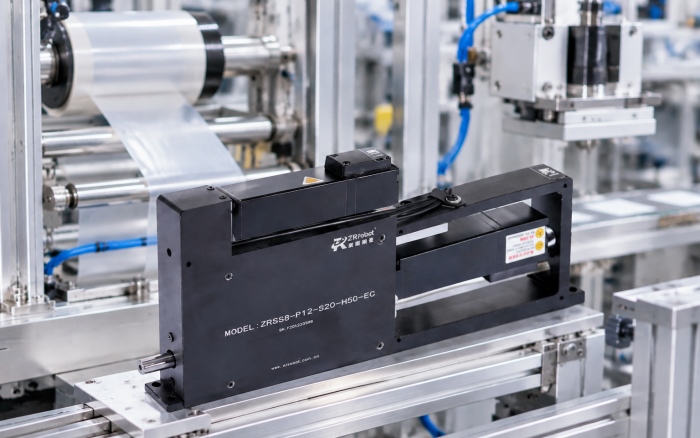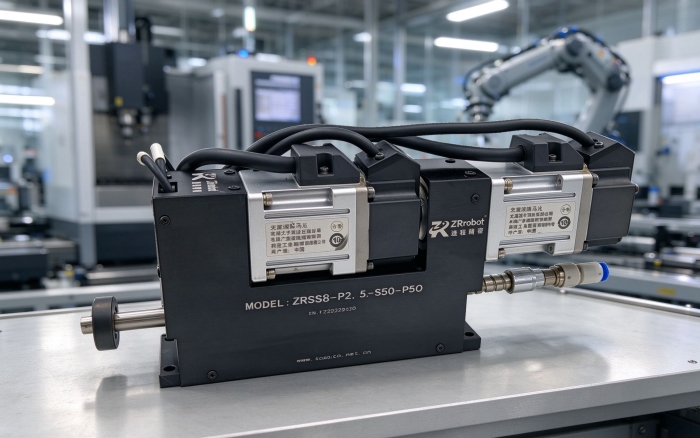


Micro-assembly processes often involve handling small, fragile components that can be damaged by excessive insertion force or inconsistent contact pressure. In industries such as 3C electronics manufacturing, even minor variations during positioning, attachment, or component insertion may cause cracks, deformation, or assembly defects. A closed-loop micro assembly actuator addresses these challenges by using real-time pressure feedback to monitor and regulate force output during operation. Consequently, it helps maintain more consistent contact conditions and supports reliable assembly across repeated production cycles.
How Does Closed-Loop Force Control Work?
Traditional motion systems typically follow predefined movement commands, but they may not respond quickly enough to changes in contact conditions during delicate assembly operations. For example, component dimensions, surface conditions, and fixture positioning can introduce variations in the resistance encountered during insertion. A closed-loop force control system uses feedback signals to monitor these changes and adjust actuator behavior accordingly. Therefore, it can provide more controlled interaction between the assembly mechanism and the workpiece.
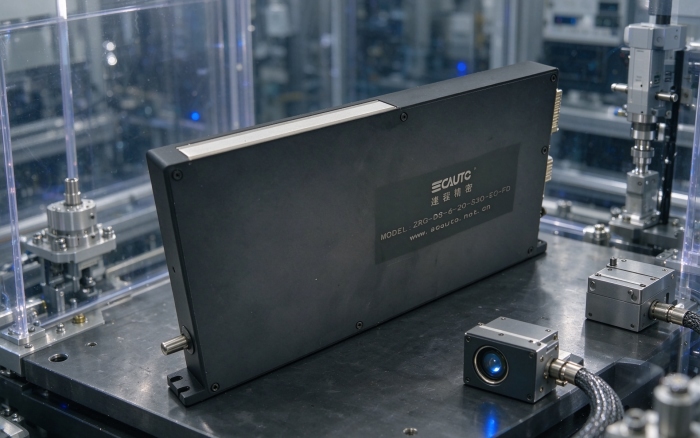
In the ZRGDS6-20 series, real-time pressure feedback works together with closed-loop force regulation to support stable motion execution. Rather than relying entirely on fixed movement settings, the system continuously monitors pressure changes and adjusts force output during operation. This approach is particularly valuable when handling fragile micro-components that require consistent contact without unnecessary mechanical stress. As a result, manufacturers can reduce process variation and improve the repeatability of precision assembly tasks.
Tip 1: Use Real-Time Pressure Feedback to Prevent Component Damage
Excessive force is one of the main risks in micro-component insertion and attachment processes. When an actuator applies more pressure than a component can tolerate, the workpiece may develop cracks, surface damage, or structural deformation. However, insufficient force can also lead to incomplete insertion or weak attachment. A closed-loop micro assembly actuator helps address both conditions by monitoring pressure changes and regulating force output throughout the operation.
Real-time feedback is especially useful when the actuator encounters variations between individual components or assembly positions. Instead of treating every operation as an identical mechanical movement, the control system can respond to changing contact conditions. Nevertheless, the appropriate force limits must still be established according to component materials, geometry, and assembly requirements. Engineers should validate these limits through testing before applying the actuator in production.
Tip 2: Coordinate Linear and Rotary Motion for Accurate Assembly
Many micro-assembly applications require more than a simple vertical insertion movement. Components may need to be positioned, rotated, aligned, and attached within a restricted working area. A linear rotary actuator combines linear and rotational movement in one module, helping equipment designers coordinate different motion stages within a compact structure. Furthermore, integrated movement can simplify the mechanical arrangement of automated assembly equipment.
A high-precision linear rotary actuator is useful when an application requires coordinated movement and accurate component positioning. Meanwhile, a precise positioning linear rotary actuator can support processes where alignment and controlled contact are important to assembly quality. For a linear rotary actuator for automatic assembly line applications, engineers should consider movement sequence, working space, component characteristics, and force requirements together. This ensures that motion coordination and force regulation support the same production objective.
Tip 3: Improve Production Consistency Through Controlled Force Output
In high-volume manufacturing, consistent assembly quality depends on controlling variations between production cycles. Even when equipment follows the same movement path, differences in component dimensions or fixture conditions can affect the actual contact force. Closed-loop regulation helps reduce dependence on fixed motion commands by incorporating real-time feedback into the operating process. Consequently, it can support more consistent handling and insertion performance across repeated operations.
The following benefits are particularly relevant to automated micro-assembly equipment:
- Reduced excessive force: Feedback-based regulation helps prevent unnecessary pressure during component contact.
- More consistent assembly: Continuous monitoring supports repeatable force output across production cycles.
- Improved handling stability: Controlled interaction helps reduce the risk of damaging delicate workpieces.
- Better process coordination: Integrated linear and rotary movement supports organized assembly sequences.
- Compact equipment integration: An ultra-thin actuator structure helps accommodate space-constrained machine layouts.
However, feedback control does not eliminate every possible assembly defect. Component quality, fixture accuracy, control settings, and mechanical installation also influence the final result. Therefore, manufacturers should evaluate the complete assembly process rather than relying on actuator performance alone.
Key Design Considerations for Micro-Assembly Applications
Selecting an actuator for fragile component handling requires a comprehensive review of both motion and force control requirements. The following table outlines several factors that equipment designers should evaluate before integrating a module into an automated production system.
| Design consideration | Purpose | What engineers should evaluate |
|---|---|---|
| Force regulation | Control contact pressure | Required force range and acceptable variation |
| Real-time feedback | Respond to changing contact conditions | Feedback response and control behavior |
| Positioning accuracy | Maintain component alignment | Workpiece dimensions and fixture tolerances |
| Linear and rotary motion | Coordinate multiple movement stages | Required travel and rotation sequence |
| Installation structure | Fit compact automation equipment | Available space and mounting arrangement |
| Production consistency | Maintain repeatable assembly quality | Cycle conditions and process validation |
In addition, engineers should assess how the actuator interacts with the machine controller and surrounding mechanical components. Proper fixture design and consistent workpiece positioning are equally important because feedback control cannot fully compensate for an unstable mechanical setup. A compound actuator for precision assembly device applications should therefore be evaluated as part of the complete machine architecture.
Typical Applications in 3C and Precision Manufacturing
Closed-loop force control is particularly relevant to manufacturing processes involving small electronic components and delicate mechanical assemblies. In 3C industry automation, equipment may need to insert connectors, attach accessories, position miniature parts, or complete precision bonding operations. These processes often require a combination of accurate movement and controlled contact force. Accordingly, integrated force control can help improve handling stability while reducing the risk of damage during repeated operations.
Other suitable application areas include micro-component loading and unloading, automated pick-and-place equipment, precision fastening lines, and semiconductor auxiliary processing systems. The ZRGDS6-20 series is designed for these types of industrial automation scenarios, combining an ultra-thin structure, integrated linear-rotary motion, and real-time pressure feedback. Zrvrobot provides actuator solutions for equipment builders and system integrators developing compact, high-precision automation platforms.
Conclusion
Preventing fragile components from cracking requires careful control of both positioning and contact force during automated assembly. Real-time pressure feedback allows a closed-loop micro assembly actuator to monitor changing contact conditions and regulate force output throughout the operating process. In addition, coordinated linear and rotary movement helps simplify equipment integration and supports repeatable handling sequences. By combining suitable force settings, stable fixtures, and properly configured motion control, manufacturers can improve process consistency in demanding micro-assembly applications.