


Modern industrial automation continues to demand higher accuracy, faster operation, and more compact mechanical designs. In precision manufacturing environments, traditional motion systems often rely on separate linear and rotary stages to achieve vertical movement and rotational positioning. However, this approach can increase system complexity, require more installation space, and create additional challenges in synchronization.
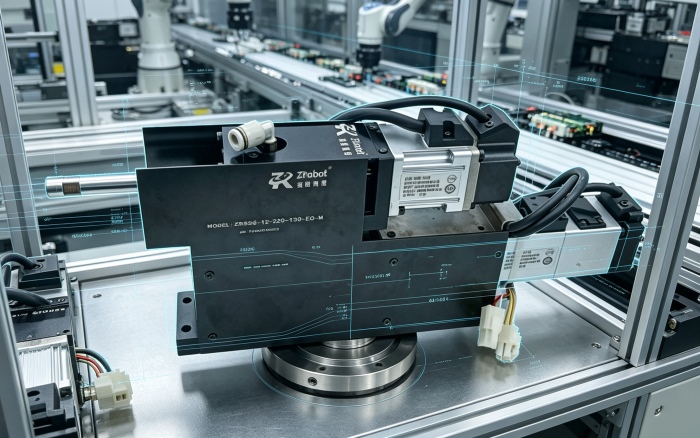
The dual-axis motion module provides a more integrated solution by combining Z-axis linear movement and R-axis rotary control into one compact structure. This Z+R integration helps improve positioning accuracy, simplify machine design, and enhance overall production efficiency. For applications requiring precise handling of micro-components and high-speed automation, an integrated motion module offers clear advantages compared with separate motion systems. Zrvrobot focuses on developing advanced automation components that help manufacturers achieve reliable and efficient motion control in compact production environments.
Z+R Integration Creates More Efficient Motion Performance
When separate linear and rotary stages are used together, each component requires independent control, mechanical alignment, and installation adjustment. Therefore, maintaining consistent coordination between different motion systems can become more complicated, especially in high-speed production lines. The dual-axis motion module integrates Z-axis lifting and R-axis rotation into a unified servo-driven structure. This design reduces mechanical connections and improves synchronization between vertical and rotary movements. As a result, automation equipment can achieve smoother operation with fewer adjustment requirements. Furthermore, the integrated structure helps reduce the overall footprint of automation systems. This makes it especially suitable for production environments where installation space is limited but high precision is required.
Compact Ultra-Thin Design for Space-Limited Applications
As industrial equipment becomes smaller and more flexible, compact motion components are increasingly important. Traditional multi-stage configurations may require additional brackets, couplings, and installation space, which can affect machine layout. The ZRDSS8-P2 series features an ultra-thin structure designed for high-speed industrial automation applications. Its compact form allows easier integration into OEM equipment while maintaining stable motion performance. Moreover, the optimized mechanical design supports lightweight system construction without sacrificing accuracy. As a result, manufacturers can develop more compact automation solutions while improving production flexibility.
High-Accuracy R-Axis Control Improves Positioning Results
Rotary positioning accuracy is essential in applications involving precise assembly, inspection, and component handling. Small positioning errors can affect product consistency and reduce manufacturing efficiency.
This motion module features high-accuracy R-axis control to deliver precise rotational positioning. Combined with the synchronized Z-axis movement, the system provides reliable multi-directional control for demanding automation tasks.
| Feature | Advantages |
|---|---|
| Z+R integrated structure | Simplifies system design and improves synchronization |
| Dual ZR-axis servo system | Provides stable and accurate motion control |
| Ultra-thin design | Supports compact machine integration |
| High-speed operation | Improves production cycle efficiency |
| Precision R-axis positioning | Enhances accuracy for detailed handling tasks |
Dual Servo System Supports Stable High-Speed Operation
High-speed automation requires motion systems that can maintain accuracy while operating continuously. Unstable movement or delayed response may affect production quality and increase downtime. The integrated dual ZR-axis servo system provides synchronized motion control with improved stability. By combining both movement functions within one module, the system reduces coordination errors and supports smoother operation during repetitive tasks. In addition, the high-speed performance helps improve production cycles, making the module suitable for automated manufacturing lines that require both speed and precision.
Optimized Design for Industrial Automation Integration
Different industries require customized automation solutions based on their production requirements. A flexible motion module should be easy to integrate while providing reliable long-term performance. The dual axis motion module adopts an OEM-ready industrial structure that allows automation manufacturers and system integrators to incorporate it into various equipment designs. Its optimized pneumatic design also contributes to smoother airflow management and stable movement.
Because of its compact structure and precise control capability, the module can support applications such as:
- Micro-component assembly
- Precision handling systems
- Electronic manufacturing equipment
- Automated inspection equipment
- High-speed production machinery
Advantages Compared with Separate Linear and Rotary Stages
Although separate linear and rotary stages can provide individual motion functions, they often require more components and additional setup processes. An integrated Z+R solution provides a more streamlined approach.
| Comparison | Z+R Integrated Module | Separate Linear & Rotary Stages |
|---|---|---|
| System structure | Compact integrated design | Multiple independent components |
| Installation | Faster integration | Requires additional alignment |
| Synchronization | Built-in coordinated control | Needs external coordination |
| Space usage | Smaller footprint | Larger installation area |
| Maintenance | Simplified management | More components to maintain |
Therefore, integrated motion technology can provide better efficiency for modern automation systems.
Reliable Motion Solutions from Zrvrobot
As automation requirements continue to evolve, manufacturers need motion systems that combine precision, speed, and compact design. Zrvrobot develops high-performance motion modules to support advanced industrial applications and improve production efficiency. By integrating Z-axis and R-axis functions into one compact solution, this technology helps manufacturers simplify machine structures while achieving accurate and stable movement.
Conclusion: The Future of Integrated Precision Motion
The transition from separate motion stages to integrated systems represents an important trend in industrial automation. Combining linear and rotary movement into one module reduces complexity while improving performance. The dual axis motion module delivers the benefits of Z+R integration through high-accuracy control, compact design, and efficient operation. For precision manufacturing applications that require reliable and flexible motion solutions, integrated technology provides a smarter way to achieve higher productivity and consistent results.