


In today’s industrial automation industry, manufacturers are constantly looking for ways to improve equipment performance while reducing development time and mechanical complexity. Traditional automation systems often require separate linear actuators and rotary stages to complete multi-directional movements. However, combining different motion components can increase design challenges, installation requirements, and maintenance costs.
The linear rotary actuator Z-axis solution provides an integrated approach by combining linear movement and rotary positioning within one compact motion system. This structure helps engineers simplify machine design, reduce component coordination issues, and achieve more efficient automation performance. As a result, it becomes an ideal choice for applications that require precise positioning, fast operation, and compact installation. Zrvrobot focuses on developing high-performance motion solutions that help OEM manufacturers and automation integrators create more efficient production systems.
Combining Linear and Rotary Motion Simplifies Machine Design
When separate linear and rotary components are used in automation equipment, engineers need additional mechanical connections, alignment adjustments, and control coordination. Therefore, system development can become more complicated, especially for machines that require frequent and precise movements. The linear rotary actuator Z-axis integrates two motion functions into a single structure, allowing vertical movement and rotary positioning to work together more efficiently. This integrated design reduces the number of mechanical parts while improving overall system coordination. Moreover, the combined structure saves valuable installation space and simplifies machine architecture. Instead of designing separate systems and managing complex synchronization processes, engineers can directly integrate one compact actuator into their equipment.
Ultra-Thin Structure Supports Compact Automation Equipment
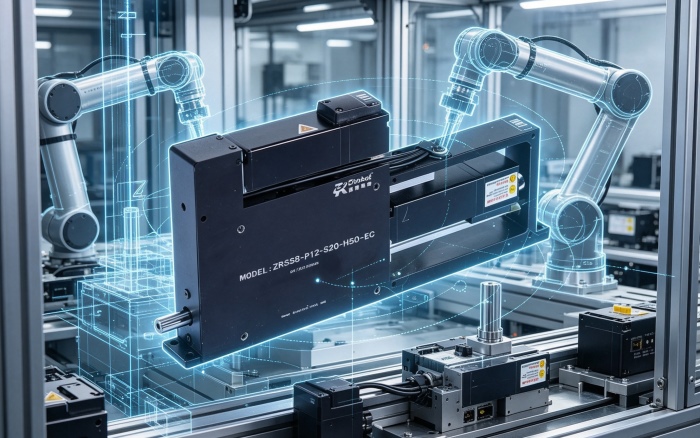
As industrial equipment continues to become smaller and more flexible, compact motion solutions are becoming increasingly important. Large motion systems may limit machine layout options and increase production equipment size. The ZRDSS8-P12 series features an ultra-thin body design that supports installation in space-limited environments. Its compact structure allows OEM manufacturers to develop smaller automation machines while maintaining stable motion performance. Furthermore, the optimized mechanical design improves integration flexibility. This makes the actuator suitable for high-speed and medium-speed automation applications where both space efficiency and precision control are required.
High-Precision ZR Dual Servo System Improves Performance
Precision and stability are essential for modern manufacturing processes. Even small positioning errors can affect product quality and reduce production efficiency.
This actuator uses a dual ZR-axis servo system to provide synchronized linear and rotary motion control. The coordinated movement improves positioning accuracy and ensures smooth operation during repetitive automation tasks.
| Feature | Benefits |
|---|---|
| Linear and rotary integrated design | Reduces system complexity and saves design time |
| Dual ZR-axis servo system | Provides synchronized and accurate motion control |
| Ultra-thin structure | Supports compact machine integration |
| High-speed operation | Improves production cycle efficiency |
| Optimized airflow design | Enhances stability during continuous operation |
Optimized Airflow Design Ensures Stable Operation
Continuous automation production requires motion components that can maintain reliable performance over long operating periods. Heat, vibration, and unstable airflow conditions may affect equipment efficiency. The ZRDSS8-P12 series adopts an optimized airflow channel design to improve operational stability. This structure helps maintain consistent motion performance during high-frequency operation and reduces potential performance fluctuations. In addition, flexible speed control supports different production requirements. Whether a production line requires high-speed movement or medium-speed precision operation, the actuator can adapt to various automation environments.
Advantages Compared with Separate Motion Components
Using independent linear and rotary stages may provide flexibility, but it often requires more design effort and additional installation processes. An integrated motion solution offers a more streamlined alternative.
| Comparison | Linear Rotary Actuator ZR Axis | Separate Linear & Rotary Systems |
|---|---|---|
| Design process | Simplified integrated solution | Requires individual component matching |
| Installation | Faster machine integration | More alignment adjustments |
| Control system | Coordinated motion control | Additional synchronization required |
| Space usage | Compact structure | Larger installation footprint |
| Maintenance | Fewer mechanical connections | More components to manage |
Therefore, integrated motion technology helps manufacturers shorten development cycles and improve equipment efficiency.
Flexible Applications for Industrial Automation
Different automation industries require precise and reliable motion control solutions. Due to its compact structure and synchronized movement capability, this actuator can support various applications, including:
- Labeling automation systems
- Film and thin-layer processing equipment
- Patch application machinery
- Auxiliary material handling systems
- Micro-component pick-and-place operations
- Automated loading and unloading systems
- Industrial assembly automation lines
Moreover, its factory-ready structure makes it suitable for OEM projects, automation equipment manufacturers, and large-scale production requirements.
Supporting OEM Integration with Reliable Motion Solutions
For OEM manufacturers and automation suppliers, reducing assembly complexity and improving production efficiency are key priorities. The integrated actuator design provides a practical solution by combining multiple motion functions into one optimized module. Zrvrobot provides precision automation components designed for reliable integration into modern industrial equipment. Through compact design, accurate control, and stable operation, the company helps customers improve automation performance and accelerate machine development.
Conclusion: A Smarter Way to Build Automation Systems
The future of industrial automation requires motion solutions that deliver higher efficiency with simpler designs. By combining linear and rotary movement into one integrated system, manufacturers can reduce design time, improve machine flexibility, and achieve more consistent performance. The linear rotary actuator Z-axis offers an effective solution for automation applications that demand precision, speed, and compact integration. With its advanced ZR-axis servo system and optimized structure, it helps engineers create smarter and more efficient production equipment.