


In modern industrial automation, engineers often expect consistent performance from robotic systems across different platforms. However, a high compatibility ZR manipulator may not always behave the same when integrated into various control environments. In addition, differences in communication protocols, motion control logic, and system architecture can significantly influence operational results. Therefore, understanding these variations is essential for stable deployment in real production lines.
Differences in Control System Architecture
One major reason a high compatibility ZR manipulator behaves differently is the variation in control system architecture. For example, PLC-based systems and PC-based motion controllers process commands in different ways. Meanwhile, real-time operating systems may prioritize motion tasks differently compared to standard industrial controllers. As a result, the same manipulator can show slight changes in response speed and trajectory behavior depending on the platform.
Communication Protocol Influence
In addition, communication protocols play a key role in system behavior. A high compatibility ZR manipulator may support multiple protocols such as EtherCAT, Modbus, or proprietary industrial buses. However, each protocol introduces different data cycle times and synchronization methods. Therefore, signal transmission speed and update frequency can vary across platforms. This leads to differences in motion smoothness and timing accuracy during operation.
Motion Control Strategy Variations
Another important factor is the motion control strategy. Different platforms apply different interpolation algorithms and acceleration profiles. For instance, some systems prioritize speed, while others focus on precision and stability. Consequently, a high compatibility ZR manipulator may respond differently depending on how motion commands are interpreted. In addition, platform-specific tuning parameters can further influence repeatability and positioning accuracy.
Integration with Zrvrobot ZRE Series Modules
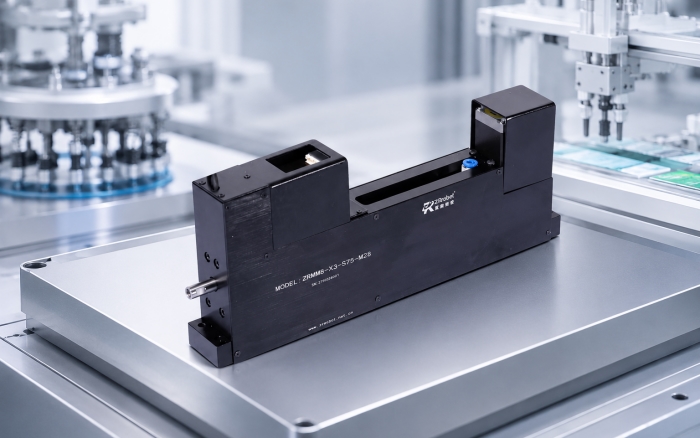
In advanced applications, Zrvrobot provides solutions such as the ZREMM8-X3 Series Long-Stroke High-Efficiency ZR Axis Module. This module features a medium air circuit design and high cost-performance optimization. Moreover, it is widely used in swing plate systems, labeling applications, film processing, and microcomponent loading and unloading. However, even with strong compatibility, integration results may still vary depending on the host automation platform. Therefore, proper system matching remains important.
Real-Time Load and Processing Differences
Furthermore, platform processing load can affect system behavior. A high compatibility ZR manipulator may receive delayed commands when the host system processes multiple tasks simultaneously. In addition, background tasks such as vision processing or data logging can compete for computing resources. As a result, motion response may appear slightly different even under identical configuration settings.
Parameter Mapping and System Tuning
Another key factor is parameter mapping between systems. Although a high compatibility ZR manipulator supports flexible configuration, each platform may interpret parameters differently. For example, speed scaling, acceleration limits, and coordinate mapping may not translate one-to-one across systems. Therefore, engineers must perform platform-specific tuning to achieve optimal performance and consistency.
Conclusion
In conclusion, a high compatibility ZR manipulator may behave differently across automation platforms due to variations in control architecture, communication protocols, motion strategies, and system load. In addition, parameter interpretation differences further contribute to performance variation. However, with proper integration and tuning, consistent and stable operation can still be achieved across diverse industrial environments. Zrvrobot continues to develop modular solutions like the ZRE series to improve adaptability and support advanced automation applications in modern manufacturing systems.