


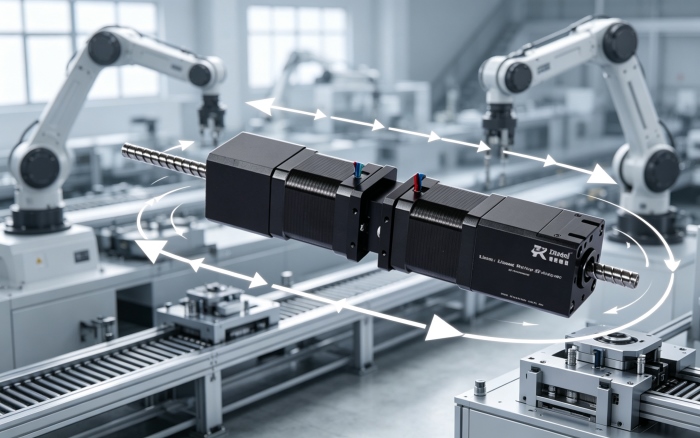
Modern automation equipment often needs to perform more than one type of movement within a limited installation space. Traditionally, linear and rotary movements may require separate mechanisms, which can increase the overall size and complexity of a machine. However, a linear rotary stepper actuator can combine these two motion functions within one compact unit, helping equipment achieve more flexible movement while simplifying mechanical integration. This type of motion solution is particularly useful for automated handling, positioning, loading, and pick-and-place operations where precise movement and efficient space utilization are important.
How Combined Linear and Rotary Motion Works
A combined motion mechanism is designed to provide controlled movement along a linear axis while also allowing rotational positioning. Therefore, a single unit can perform sequential or coordinated actions that might otherwise require multiple components. Linear movement can move a workpiece toward or away from a target position, while rotary movement can change its orientation before the next operation. As a result, this configuration can help reduce mechanical complexity and improve the flexibility of automated processes. For equipment designers, integrating multiple motion functions into one module can also make system layouts more compact and easier to organize.
Compact Design for Space-Limited Equipment
Space is often a major consideration when developing modern automation machinery. The Compact ZR Axis Module features an ultra-small structure that allows it to fit into equipment where installation space is limited. Furthermore, its compact construction can help engineers optimize the internal arrangement of mechanical and pneumatic components without sacrificing motion functionality. This makes the module suitable for compact production equipment, auxiliary mechanisms, and automated stations where every millimeter of installation space matters. Consequently, manufacturers can build more streamlined machines while maintaining the movement required for production tasks.
Fast Motion for Improved Automation Efficiency
Production lines often depend on rapid and repeatable movements to maintain stable throughput. The Compact ZR Axis Module supports high-speed motion, allowing automated systems to complete movement cycles efficiently. In addition, fast response can help reduce unnecessary waiting time between different production steps. When integrated into applications such as material handling, labeling, or pick-and-place systems, the module can contribute to smoother workflow and improved equipment productivity. Therefore, combining compact construction with rapid movement provides a practical solution for automation systems that require efficient cycle times.
Stable Pneumatic Performance
Motion quality depends not only on speed but also on stability and control. The Compact ZR Axis Module uses a medium pneumatic system and an optimized pneumatic circuit to support smoother movement. As a result, the actuator can provide more controlled motion during automated operations. Moreover, pneumatic operation can be well suited to factory environments where repeated movement cycles are required. By balancing movement speed with pneumatic stability, the module helps equipment maintain consistent operation during continuous production.
Soft Landing Protects Components and Materials
High-speed movement can create impact when an actuator reaches its end position, especially when handling delicate materials or small components. Therefore, a soft-landing function is an important advantage for applications that require controlled stopping. The Compact ZR Axis Module uses soft landing to reduce sudden impact during movement, helping protect both the mechanism and the handled material. Furthermore, smoother stopping can reduce unnecessary mechanical stress and contribute to longer component life. This feature is especially useful in applications involving micro-components, films, labels, coatings, and other materials that require careful handling.
Key Advantages for Automation Systems
The combination of compact construction, fast movement, pneumatic stability, and controlled landing provides several practical advantages for automation equipment. In particular, the module can help simplify equipment layouts while supporting efficient production cycles.
- Dual-motion capability: Combines linear positioning and rotary movement within one motion solution.
- Ultra-compact structure: Fits easily into space-limited automation equipment.
- High-speed operation: Supports rapid movement cycles for improved throughput.
- Soft landing: Helps reduce impact during positioning and protects sensitive components.
- Optimized pneumatic circuit: Promotes smoother and more stable operation.
- Factory-ready design: Supports integration into automated production equipment.
- Cost-efficient structure: Reduces the need for separate motion components in suitable applications.
Linear and Rotary Motion Compared with Separate Mechanisms
Using separate linear and rotary mechanisms can provide flexibility, but it may also require additional mounting space, components, and control arrangements. By comparison, an integrated linear rotary stepper actuator can combine movement functions within a more compact configuration. This can reduce the number of mechanical elements required for certain automation tasks. In addition, fewer components may simplify equipment layout and installation. However, the ideal configuration still depends on the required travel, rotation angle, load, speed, and control method. Therefore, engineers should select the motion architecture according to the specific machine requirements.
| Motion Solution | Main Function | Space Requirement | Typical Advantage |
|---|---|---|---|
| Linear mechanism | Straight-line movement | Moderate | Simple positioning |
| Rotary mechanism | Angular movement | Moderate | Orientation control |
| Combined motion module | Linear + rotary movement | Compact | Flexible motion in limited space |
Applications in Industrial Automation
The Compact ZR Axis Module can support a wide range of automated production processes. In labeling systems, it can assist with controlled positioning and material handling. Similarly, film and coating equipment can benefit from stable movement when processing thin or sensitive materials. In patch and adhesive applications, controlled positioning can improve handling accuracy. Furthermore, micro-component pick-and-place systems can use compact motion components where installation space is restricted. Automated loading and unloading systems can also benefit from rapid movement and soft landing, while factory production lines can integrate the module into auxiliary mechanisms that require repeated and reliable motion.
Supporting Scalable Automation Integration
Automation equipment needs to remain flexible as production requirements change. Therefore, compact motion modules can help manufacturers develop equipment that is easier to integrate into different production stations. The ZR Axis Module is designed for factory automation and can support OEM and system-level integration. Moreover, its compact structure allows multiple modules or other components to be arranged efficiently within a machine. This flexibility can be valuable for production lines that need to handle different materials, product sizes, or processing stages.
Why Choose Zrvrobot?
Zrvrobot focuses on motion solutions for industrial automation applications that require compact construction, stable operation, and efficient movement. The Compact ZR Axis Module combines an ultra-small structure with high-speed motion, an optimized pneumatic circuit, and a soft-landing function. Furthermore, its factory-ready design makes it suitable for automated equipment and production line integration. For automation engineers looking to reduce mechanical complexity while maintaining practical motion performance, this module offers a compact approach to equipment design.
A Compact Solution for Flexible Motion
A linear rotary stepper actuator can provide a practical way to combine different movement requirements within one compact mechanism. By integrating linear positioning and rotary orientation, it can reduce the need for separate motion components in suitable automation applications. Meanwhile, the Compact ZR Axis Module adds high-speed operation, pneumatic stability, soft landing, and space-saving construction to support demanding factory environments. Consequently, it can serve as a useful motion component for labeling, coating, material handling, pick-and-place, and automated loading applications where compact and flexible movement is essential.